These Unsettling Fairy Photos Proved Digital Manipulation Was Always Coming

Updated: May 15
In 1917, tiny-winged beings were caught on camera.
And because there were photos, people believed them.
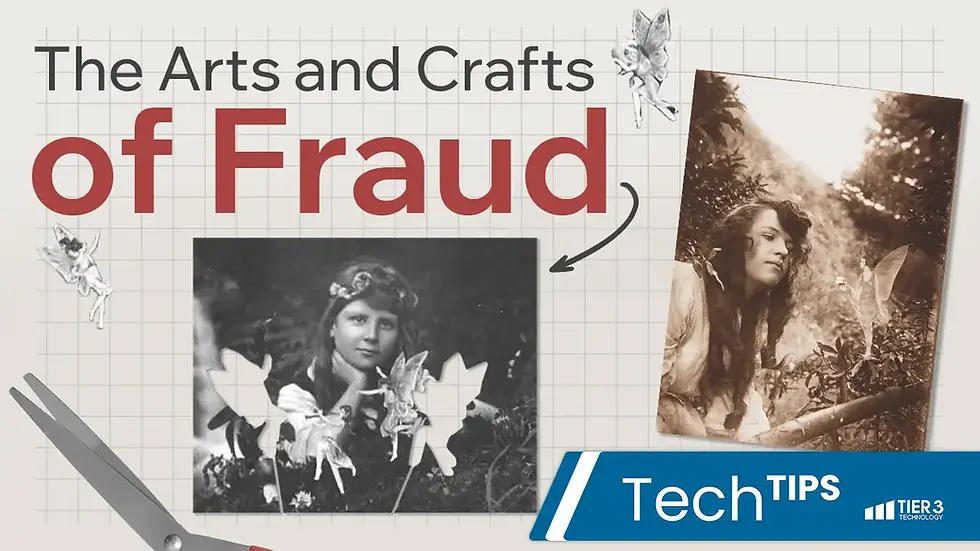
Proof of the Cottingley Fairies and the History of Digital Manipulation
In 1917, cousins Elsie Wright and Frances Griffiths were living in Cottingley, a village near Bradford, England. And like many children, they spent their time playing, using their imagination for all sorts of things.
One of those things was fairies.
But unlike many children, they came back with photos that showed them hanging out with fairies in the garden.
Elsie’s father, Arthur Wright, developed the photos himself.
Elsie’s mother showed the photos at a meeting of the Theosophical Society, where they caught the attention of Edward Gardner, a prominent member of the group.
The photos eventually reached Sir Arthur Conan Doyle, the author of Sherlock Holmes.
Yes, the author of that Sherlock Holmes.
The Author of Sherlock Holmes Became One of the Most Famous Believers in the Photographs
Doyle used the images in a 1920 article for The Strand Magazine, helping turn the Cottingley Fairies into a public sensation.
The truth came much too late. In the 1980s, Elsie and Frances admitted that most of the fairy photos had been staged using paper cutouts copied from a children’s book.

Why People Believed the Fairy Photos
At the time, photography carried a lot of authority. If something appeared in a photo, it was evidence. A camera was supposed to capture reality, not participate in the arts-and-crafts version of fraud.
This was long before the modern era of digital manipulation.
And this is what gave the paper fairies an advantage.
The Cottingley Fairies worked because they arrived at the perfect intersection of photography, imagination, and people really wanting the world to be a little more magical than it was.
It gave people something to believe in.
The Same Is True Today
Photos don’t always convince people by showing them something completely unbelievable. It often works by showing them something they already hope is true or fear is true.
The Cottingley Fairies may have been made from paper, but they understood the assignment.
A convincing image doesn’t have to be perfect. It only needs to be believable enough for the people looking at it.
What the Cottingley Fairies Teach Us About Digital Manipulation
The Cottingley Fairies weren’t digitally manipulated in the way that we think of today.
There was no Photoshop. No AI.
But the basic idea was the same: create an image convincing enough, and people may believe what they are seeing before they decide to question it.
We Treat Images Like Proof
Photographs have a way of skipping past skepticism.
The story sounded impossible, but the photos made it feel, well, possible.
What’s that old saying? A picture is worth a thousand words.
Unfortunately, now some of those words are lies.
We Want Certain Things to Be True
The fairy photos worked partly because people wanted them to be real.
They offered wonder. Mystery. A tiny glittery escape from normal life, which honestly is understandable.
Normal life, after all, has bills.
We React Before We Research
The Cottingley Fairies spread because people saw the photos and reacted to what they appeared to show.
We see an image. We feel something. We share it. Then, maybe later, someone checks whether it was real.
It’s not exactly a reliable process.
That begs the question: what happens when reality can be rendered?
By the time someone asks, “Is this legit?” the image has likely already traveled through group chats, social feeds, inboxes, and comment sections.
How to Protect Yourself from Digital Manipulation
You don’t have to be Sherlock Holmes.
Which is good, because the guy who created the legendary detective fell for the fairies.
So, what do you really need to do?
1. Slow Down
Digital manipulation works best when people react quickly. A shocking AI image, a fake screenshot, or an edited photo can spread fast because it gives people something to feel before they think to question it.
2. Check the Source
Before trusting an image, look where it came from. Who posted it? Is it from a reliable news outlet? And if an image is tied to a major event, see if other trustworthy sources are sharing the same information.
3. Treat Digital Manipulation Like a Cybersecurity Issue
Digital manipulation isn’t just about fake fairy photos or strange AI images on social media. It can be used in phishing scams, fake invoices, impersonation attempts, fraudulent ads, fake employee profiles, and a host of other social engineering attacks. That’s why it’s crucial to invest in reliable cybersecurity services.
Final Thoughts on Digital Manipulation
The Cottingley Fairies may seem harmless now: two girls, paper cutouts, and a famous author who probably should have asked a few more Sherlock Holmes-level questions.
But the real lesson is even simpler.
The "facts" are always worth checking twice.
—
Danielle Mundy is the Marketing Coordinator for Tier 3 Technology. She graduated magna cum laude from Iowa State University, where she worked on the English Department magazine and social media. She creates engaging multichannel marketing content—from social media posts to white papers.

Comments