This Legendary Viking King Will Change How You Look at the History of Bluetooth

Updated: Feb 2
When most people think of Vikings, they think of battle-thirsty men with unruly beards and horned helmets ready for war. The last words that usually come to mind are “civilized” or “tech-savvy.”
Believe it or not, Vikings have a fair amount to do with one piece of modern technology—one that you likely use every day.
Who would’ve guessed that Vikings would have anything to do with the history of Bluetooth?
Bluetooth is a short-range wireless technology standard that people use to connect two different devices so they work together. A “standard” just means that any manufacturer who wants to include this feature in their product will need to follow certain requirements.
A good example of this is listening to music on Bluetooth headphones with name-brand phones. Think of using your Apple AirPods with your iPhone or your Samsung Galaxy Buds with your Google Pixel. You need to have Bluetooth on your phone to use the headphones.
Naming the Technology: How a Viking King Shaped the History of Bluetooth
If we’re going to talk about the history of Bluetooth, we need to go back in time, to circa 911 AD.
King Harald “Bluetooth” Gormsson was born around this time and ruled parts of Scandinavia. He is credited with being the first person to unify Denmark and consolidate Danish rule. His nickname, “Bluetooth,” according to historical accounts, likely comes from the theory that he had a dark-colored (possibly dead) tooth.
Fast forward some thousands of years later, Jim Kardach, an engineer at Intel, was inspired by a book about Vikings he was reading and a conversation he’d had with another engineer, Sven Mattisson. Kardack proposed that, at least for the time being, the wireless technology be named “Bluetooth,” a nod to how King Harald Bluetooth united Scandinavia, like wireless technology would unite devices.
According to Bluetooth’s official website, “Bluetooth was only intended as a placeholder until marketing could come up with something really cool.” Top contenders were either RadioWire or PAN (Personal Area Networking).
PAN was the primary choice, but there were already tens of thousands of hits for it on the internet. A full trademark search for RadioWire couldn’t be completed in time for launch, making Bluetooth their only option.
The name caught on quickly—and why wouldn’t it? It was named after a Viking king. There’s not a much cooler name than that. Talk about making an impression.
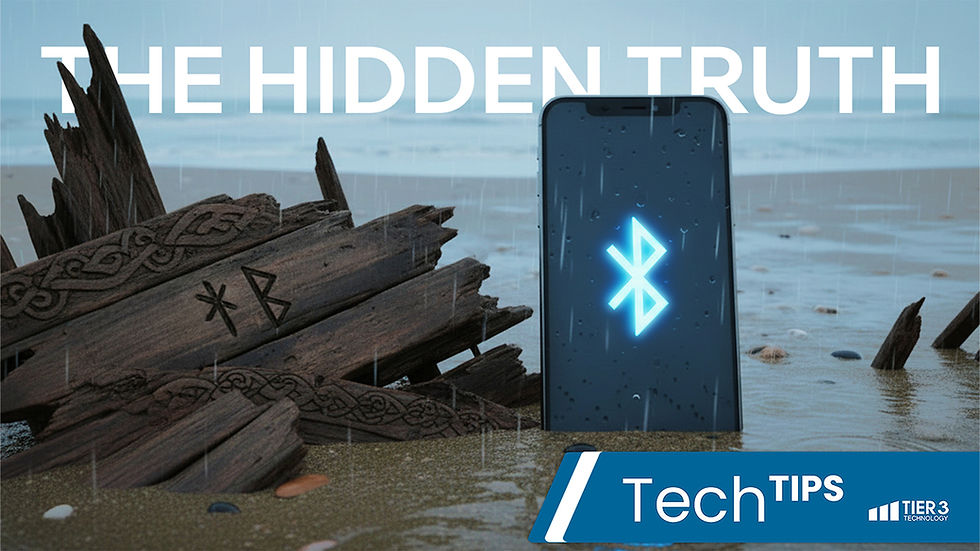
To top it all off, the iconic Bluetooth logo we see so often today also pays homage to King Harald. When the logo was designed, it was done by combining two Younger Futhark runes, his initials H (ᚼ) and B (ᛒ).
And Bluetooth isn’t the only everyday technology with an unexpected origin story. Some inventions emerged from surprisingly small problems, like those of an empty coffee pot.
When Did Bluetooth Technology Come Out?
Bluetooth had been in the making since the mid-1990s, but when did Bluetooth come out to the public?
The first public demonstration of Bluetooth was in 1999 at COMDEX, a computer expo trade show that began in 1979 and continued until 2005. It was here that a Bluetooth hands-free mobile headset won the “Best of Show Technology Award.”
What followed was the beginning of Bluetooth becoming a prevalent part of modern day. The first commercially available Bluetooth phone, the Ericsson T39, was released in stores in 2001.
The History of Bluetooth
The timeline for the history of Bluetooth is much shorter than one might expect, especially considering how far it’s come. While the idea for the name dates back to 911 AD, the history of the product itself began in 1994 and continues to the present day.
1994: Mobile phones were growing in popularity at this time, and the Ericsson Mobile Communications company wanted to find a way to improve their functionality. It was at this time that Dr. Jaap Haartsen, a Dutch electrical engineer, was assigned to develop the product.
1996: Business leaders from multiple tech companies met with each other to talk about how the technology could be standardized across industries. Intel employee Jim Kardach suggested a codename. He suggested Bluetooth because he felt that Harald’s unification of Denmark and Norway was similar to what they were doing with wireless technology and other devices.
1999: With the name established, companies could start integrating the technology into their products. This was the year that the Bluetooth hands-free headset won the “Best of Show” award at COMDEX.
2001: The first ever mobile phone to use Bluetooth technology was the Ericsson T36; however, this model never made it to the stores. It was the Ericsson T39 (a revised version of the T36) that became available to consumers.
2024: The most recent version of Bluetooth, Bluetooth 6.0, was released in late 2024. Previous versions focused on security and supporting smart devices. It introduced features like Channel Sounding for improved device location accuracy and better IoT capabilities.
Modern Relevance of the History of Bluetooth
Bluetooth was designed from the beginning to be a low-power, low-cost wireless solution. These early design priorities continue to shape both wireless technology and its related industries. Bluetooth is now the backbone of modern connectivity, powering everything from earbuds and infotainment systems to gaming controllers and smart devices.
The success of Bluetooth lies in its adaptability. Each new version has introduced improvements in range, energy efficiency, audio quality, security, and now device-location accuracy.
These changes enable Bluetooth to remain relevant in a world that is constantly changing.
In addition, as Bluetooth has become the backbone of modern connectivity, it has also introduced new cybersecurity considerations around device pairing, wireless access, and data transmission.
But the greatest part? A piece of ancient Viking history remains quietly embedded in nearly every digital interaction. Every time you put on wireless headphones or pair your phone to your car, you’re invoking the legacy of King Harald Bluetooth.
Conclusion: Reflecting on the History of Bluetooth
The history of Bluetooth is more than a tale of technological innovation. It’s a reminder that history has a funny way of weaving itself into the present, sometimes in places you’d never think to expect.
—
Danielle Mundy is the Content Marketing Specialist for Tier 3 Technology. She graduated magna cum laude from Iowa State University, where she worked on the English Department magazine and social media. She creates engaging multichannel marketing content—from social media posts to white papers.


Comments